Structure
1. Introduction: Crypto License and the Role of Cryptocurrency Lawyers 2. What services are regulated by CASP? 3. How to get a CASP license? 4. When will the new rules come into force? 5. Benefits of the CASP license 6. Who needs a crypto license? 7. VASP vs CASP: What is the difference between these crypto licenses? 8. Arrange a Meeting 9. Frequently Asked Questions 10. News1.
Introduction: Crypto License and the Role of Cryptocurrency Lawyers
A Crypto License is a legal permit that allows a company to provide services related to virtual assets. Such a license is usually issued by a government or regulatory body responsible for ensuring that companies comply with relevant laws and regulations.
To obtain a Crypto License, it is necessary to meet certain requirements set by local laws. The specific criteria for obtaining such a license may vary from jurisdiction to jurisdiction, but generally include providing personal, tax and financial documents, as well as demonstrating technical knowledge of how the cryptocurrency market works. In addition, anti-money laundering (AML) and CTF (Counter Terrorist Financing) regulations must be strictly followed. A virtual asset service provider is also often required to implement robust KYC (Know Your Customer) and transaction monitoring procedures, as well as conduct regular audits and keep detailed transaction records.
With the adoption of the Markets in Cryptoassets Act (MiCA), the European Union is setting clear rules for the cryptocurrency sector, ensuring transparency, security and a uniform legal regime for all its participants. The new regulation introduces a unified licensing system that will replace the existing classification of VASPs (Virtual Asset Service Providers) with CASPs (Crypto Asset Service Providers).
A crucial role in the process of obtaining and maintaining a Crypto License is played by fintech lawyers, who specialize in the legal aspects of financial technologies and digital assets. They help companies navigate complex regulatory frameworks, prepare the required documentation, and ensure compliance with AML, KYC, and other international standards. Professional fintech lawyers also provide strategic advice on structuring business operations across different jurisdictions, making it easier for companies to expand their services globally while minimizing legal risks.
2.
What services are regulated by CASP?
The CASP license covers a wide range of crypto-asset related activities, including:</h6?
- Storage and management of digital assets for clients;
- Management of trading platforms for cryptocurrencies;
- Exchange of crypto assets for fiat money and other digital assets;
- Execution of orders for the purchase of crypto assets;
- Listing of new tokens on the market;
- Reception and transmission of orders for crypto assets;
- Consulting services in the field of cryptocurrencies;
- Management of cryptocurrency portfolios;
- Conducting cryptocurrency transactions.
3.
How to get a CASP license?
Any crypto company wishing to provide these services in any EU country must go through the licensing process. Companies that already have a VASP license must re-apply for a CASP to the relevant regulator in their jurisdiction. For more detailed information, please contact our specialists!
4.
When will the new rules come into force?
MiCA came into force in early 2025, now crypto companies must adapt to the new requirements.
5.
Benefits of the CASP license
- Access to the entire EU market – legal work in all EU countries;
- Increased trust from clients and investors;
- Transparency and reliability of business in accordance with European standards.
6.
Who needs a crypto license?
- Crypto exchangers are platforms that allow users to buy, sell and exchange cryptocurrencies.
- Crypto wallets and custodial services are companies that offer storage and management of clients’ digital assets.
- Crypto payment services are payment gateways and providers that enable businesses to accept cryptocurrency payments.
- DeFi platforms (decentralized finance) are services that provide loans, asset exchange, staking and other financial services based on blockchain.
- Crypto brokers and OTC dealers are companies that deal with large over-the-counter crypto transactions.
- ICO, IEO, STO providers are platforms that organize the initial placement of tokens to attract investments.
- Crypto funds and investment companies are organizations that work with digital assets and offer cryptocurrency investments to clients.
- Mining companies are businesses that mine cryptocurrencies and require a license in a number of jurisdictions.
7.
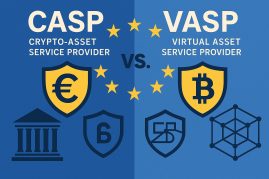
VASP vs CASP: What is the difference between these crypto licenses?
As digital asset legislation evolves, cryptocurrency companies are faced with new regulatory requirements. In the European Union (EU), VASP (Virtual Asset Service Provider) is gradually being replaced by CASP (Crypto Asset Service Provider) under the new Markets in Cryptocurrency Act (MiCA). Let’s look at the differences between them and what this means for the crypto business.
What is VASP?
VASP (Virtual Asset Service Provider) is a term used in international regulation of the cryptocurrency sector. It was introduced by the FATF (Financial Action Task Force on Money Laundering) to designate companies working with digital assets.
The following are covered by VASP:
- Cryptocurrency exchanges (spot and futures);
- Custodial wallets;
- Fiat-to-crypto exchange platforms;
- Crypto payment gateways;
- OTC dealers and brokers;
- DeFi projects with centralized functions.
What is CASP?
CASP (Crypto Asset Service Provider) is a new legal category introduced by MiCA (Markets in Crypto-Assets Regulation). This law unifies the regulation of the cryptocurrency sector in all EU countries and introduces uniform licensing requirements.
The following are subject to CASP:
- All VASP categories;
- Management of trading platforms for crypto assets;
- Placement of crypto assets on the market;
- Management of a portfolio of crypto assets;
- Consulting on crypto assets;
- Providers of staking and lending.
At LAWSKAR, we provide end-to-end support in obtaining crypto licenses for your business under the new MiCA regulatory framework and beyond. Whether you’re operating a digital wallet service, a crypto exchange, or a token-issuing platform, our legal team ensures your operations align with the most recent compliance standards — from application to post-license maintenance.
One of the most impactful benefits of acquiring a crypto license is the expanded business reach it provides. With a CASP license, your company gains access to the entire EU crypto market under a harmonized regime. This eliminates the need to acquire multiple licenses across different member states and allows you to scale more rapidly. Crypto licenses also increase investor confidence, enhance consumer trust, and unlock access to traditional banking services, which often remain closed to unlicensed operators.
A licensed status also makes it significantly easier to list your crypto assets, onboard users, and work with fiat gateways. In fact, many institutional investors and financial counterparties now require CASP authorization as a baseline standard for cooperation. Without such a license, the risk of reputational damage or regulatory penalties is much higher — especially in high-compliance environments like the EU, Singapore, and Switzerland.
However, meeting all licensing requirements is far from a simple task. The cost of securing a crypto license varies depending on your business model and jurisdiction — ranging from €25,000 to over €150,000. Additional regulatory costs, such as AML implementation, compliance staffing, local office requirements, and internal control systems, must also be accounted for. That’s why we work closely with each client to map the optimal path forward based on the scope of operations, targeted markets, and business risk appetite.
At LAWSKAR, our crypto lawyers provide jurisdictional analysis, business structuring, and licensing services tailored to your needs. Whether you’re seeking to operate in Lithuania, Poland, or under another reputable regulator, our team ensures that all crypto license requirements — including internal AML/KYC policies, transaction monitoring systems, and local director mandates — are handled with precision and foresight.
The new MiCA rules have changed the pace and standards of compliance, but they also offer unmatched clarity and scalability. Working with our legal experts guarantees you are not only prepared for today’s regulatory challenges, but also ready to capitalize on tomorrow’s opportunities. We help crypto companies operate transparently, build legal resilience, and accelerate growth across regulated markets.
Contact Us
Still have questions?
Fill out the form below and our lawyers will contact you shortly for a consultation.
- Response within one business day
- Free initial consultation
JLMKAR
300+ clients
already trust Lawskar
already trust Lawskar
Thank you!
Your request has been sent. Our lawyer will contact you within one business day.
8.
Arrange a Meeting
arrange a meeting
Contact
If you have any questions, suggestions or need advice, we are happy to help! Contact us in your preferred messenger:

Aleksei Shulyakovsky
Our professional team will find the best solution for your business!
Position
CEO, Founder LAWSKAR
lawskarglobal@gmail.com
9.
Frequently Asked Questions
Which regulatory body oversees the licensing of CASPs?
In each EU country, the CASP licensing process is overseen by national financial regulators. However, MiCA sets uniform standards for all countries.
Some key EU regulators:
- BaFin (Germany)
- AMF (France)
- FMA (Austria)
- FIU (Lithuania, Estonia)
- MFSA (Malta)
After receiving a CASP license in one EU country, the company gains the right to provide services throughout the European Union (passporting).
What are the basic requirements for obtaining a CASP license?
Standard requirements include:
- Compliance with AML/CFT (Anti-Money Laundering and Combating the Financing of Terrorism) rules
- Availability of authorized capital (from 50,000 to 150,000 euros, depending on the type of activity)
- Physical presence in the country of registration (office, employees)
- Transparent ownership structure
- Technical security (data and crypto assets protection mechanisms)
- Internal control and risk management system
- Appointment of responsible persons (AML officer, compliance director)
How long does it take to obtain a CASP license?
The process of obtaining a CASP license takes on average 3 to 6 months, but may vary depending on the country and the complexity of the application.
Factors affecting timing:
- Due Diligence
- Passing AML/KYC compliance
- Certification of technical infrastructure
- Interaction with the regulator
What documents and information are required to apply for a CASP license?
The standard package of documents includes:
- Company founding documents
- Information about owners and management (passport data, biographies)
- Business plan and financial model
- AML/CFT policy
- Description of IT infrastructure (security, data protection)
- Documents on the availability of authorized capital
- Documents on individuals (managers, shareholders, compliance officers)
The exact list may vary by country. It is recommended to consult with a MiCA legal advisor before submitting an application.
If I want to open a company outside the EU, do I need to get a CASP license?
No – you do not need to obtain a casp license, you will work in a simplified manner under a VASP license, for example, a company in Canada, Georgia, Kazakhstan, etc.